Calibration target benchmarking

One calibration target. Observed reconstructions.

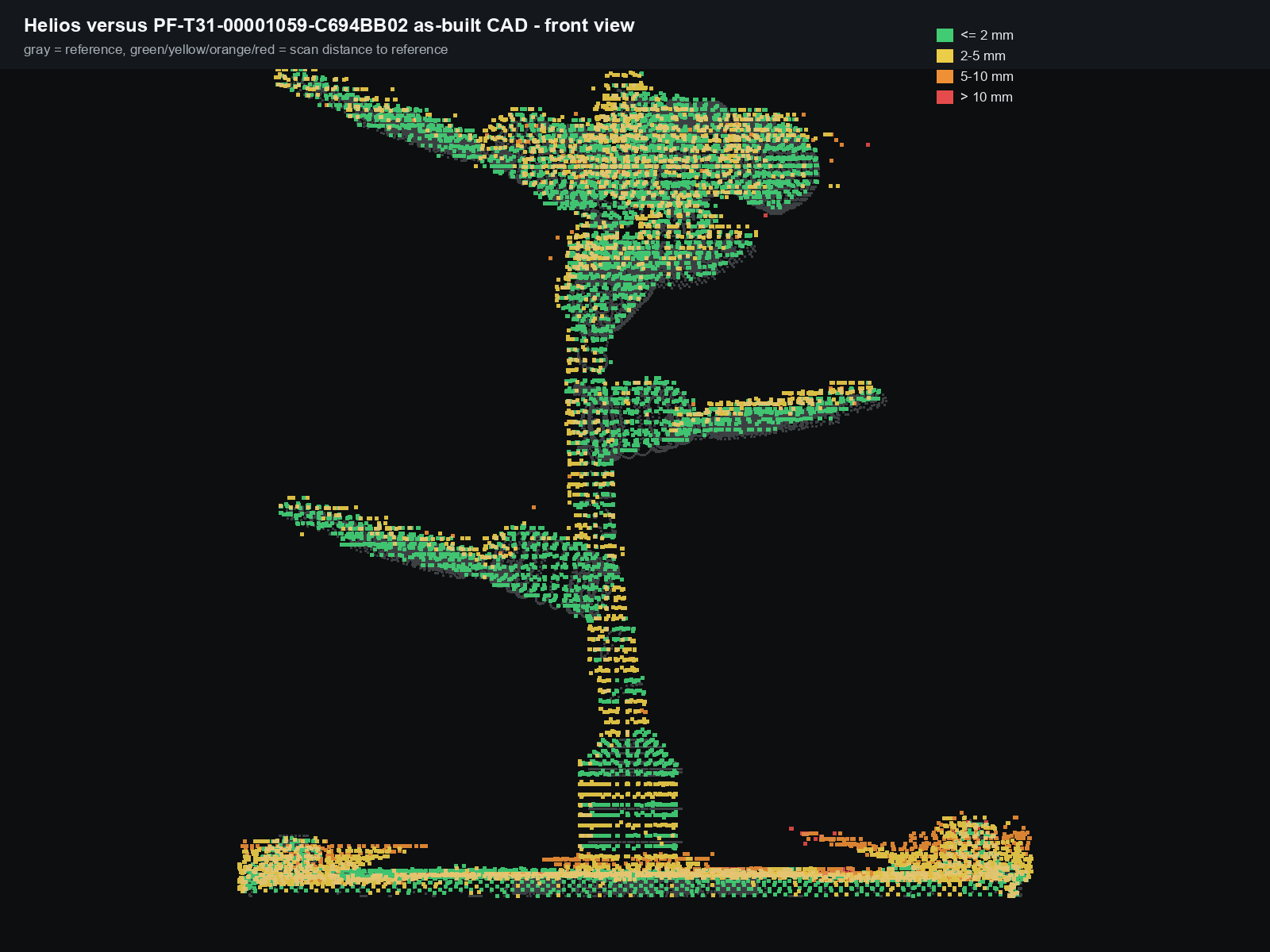
Helios, iPhone 12 Pro Max, iPhone 15 Pro Max, and iPhone 17 Pro Max reconstructions are shown against the same corrected CAD for PF-T31-00001059-C694BB02.

Make this target iPhonoBenchy opens the editable Tomato calibration target: adjust its geometry, inspect it in 3D, and export an STL for Helios, iPhone, or another 3D imaging platform.

Calibration target benchmarking

Observed reconstructions

Helios and the iPhone reconstructions against the same CAD target.

Loading comparison…

Interactive 3D

The CAD and observed reconstructions

View the PF-T31 Tomato calibration target, Helios, and the iPhone reconstructions together.

Representation
Exact STL reference model

The original STL is the common reference for the CAD measurements shown on this page.

Interactive registered geometry

Inspect the corrected canonical geometry yourself

Choose a system to inspect its registered geometry and CAD residuals in 3D.

Helios absolute distances are recomputed against the frozen 100,000-point CAD sample. Signed-normal colour remains a Helios-only residual field; signed-normal mode is unavailable for every phone.

Choose Helios or an iPhone scan with the system menu. The point overlay is accompanied by keyboard-accessible camera presets, the full comparison table below, and downloadable metrics. Point-by-point picking requires a pointer.

How to read the results

Accuracy and support belong together

Scan→CAD describes the reconstructed surfaces that exist. CAD→scan describes how completely the reconstruction supports the reference target. Both are required to interpret every final result.

ReconstructionCAD

How close is the geometry that actually exists?

MetricMedian / p95
DirectionLower is better
MeaningGeometry that exists

A low value can still describe a partial reconstruction: absent surfaces contribute no scan samples in this direction.

CADReconstruction

How completely does the reconstruction support the target?

MetricCAD within 2 / 5 mm
DirectionHigher is better
MeaningTarget surface supported

CAD→scan and threshold completeness account for the plate, base, leaves, branches, fruits, and other expected target surfaces.

Published reconstruction detail

Explore the geometry and full common score

All systems are scored against the same CAD target at fixed native scale. Lower distances are better; higher CAD support is better.

CAD support at 2 mm62.13 · 76.48 · 75.59 · 67.41%

Helios · iPhone 12 · iPhone 15 · iPhone 17.

CAD support at 5 mm97.32 · 98.54 · 94.52 · 99.17%

Helios · iPhone 12 · iPhone 15 · iPhone 17.

Scan→CAD median1.018 · 0.753 · 1.005 · 0.933 mm

Helios · iPhone 12 · iPhone 15 · iPhone 17.

CAD→scan p954.639 · 4.607 · 5.067 · 4.107 mm

Helios · iPhone 12 · iPhone 15 · iPhone 17.

Symmetric mean1.717 · 1.343 · 1.497 · 1.466 mm

Helios · iPhone 12 · iPhone 15 · iPhone 17.

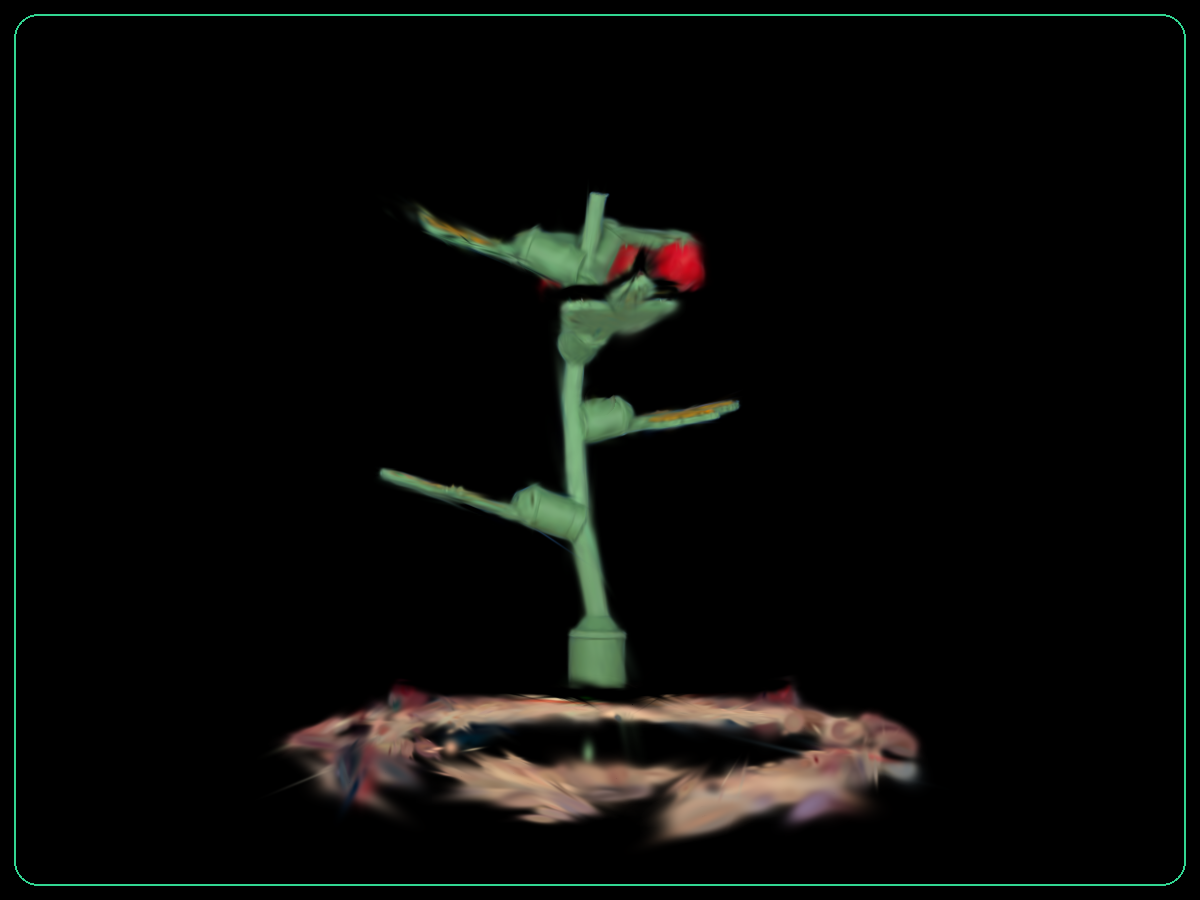
Front appearance render of the Helios Gaussian splat
Helios · Gaussian splat · front appearance render

Primary common surface comparison

Bold cells mark the lowest or highest value in each row.

100k CAD samples · lower ↓ or higher ↑
Final Helios, iPhone 12, iPhone 15, and iPhone 17 calibration-target results.
MetricHeliosiPhone 12 Pro MaxiPhone 15 Pro MaxiPhone 17 Pro Max
Loading the final comparison data…

Each value is measured against the shared CAD target. Use the interactive views above to inspect the corresponding reconstructions and CAD residuals.

The iPhone results are Apple Object Capture meshes. The interactive appearance views are included for visual comparison; use the CAD error metrics for geometric comparison.

Projection-angle screen

Twenty-four views mark the image-space knee

The screen characterizes angular redundancy. It identifies which subset to reconstruct next; it does not prove reduced-view 3D equivalence.

24 views 80.03 held-out image score
versus
60 views 81.14 held-out image score
Estimated sweep 11:06 22:12 saved versus 72 views
Balanced subset screenHeld-out composite coverage
Selected phasePhase range

The 72-view value is not connected: with no held-out frames, its 100% score is definitional and not comparable to this curve.

Explore a balanced orbit24 selected views
Score80.03
Sweep11:06
Largest gap15°
Angles 5, 20, 35, 50, 65, 80, 95, 110, 125, 140, 155, 170, 185, 200, 215, 230, 245, 260, 275, 290, 305, 320, 335, 350
24

Recommended first rerun. Exact 15° spacing on the available 5° lattice; only 5.9% more held-out proxy error than 60 views.

20

Aggressive lower bound. Alternating 15°/20° gaps; 17.9% more held-out proxy error than 60 views.

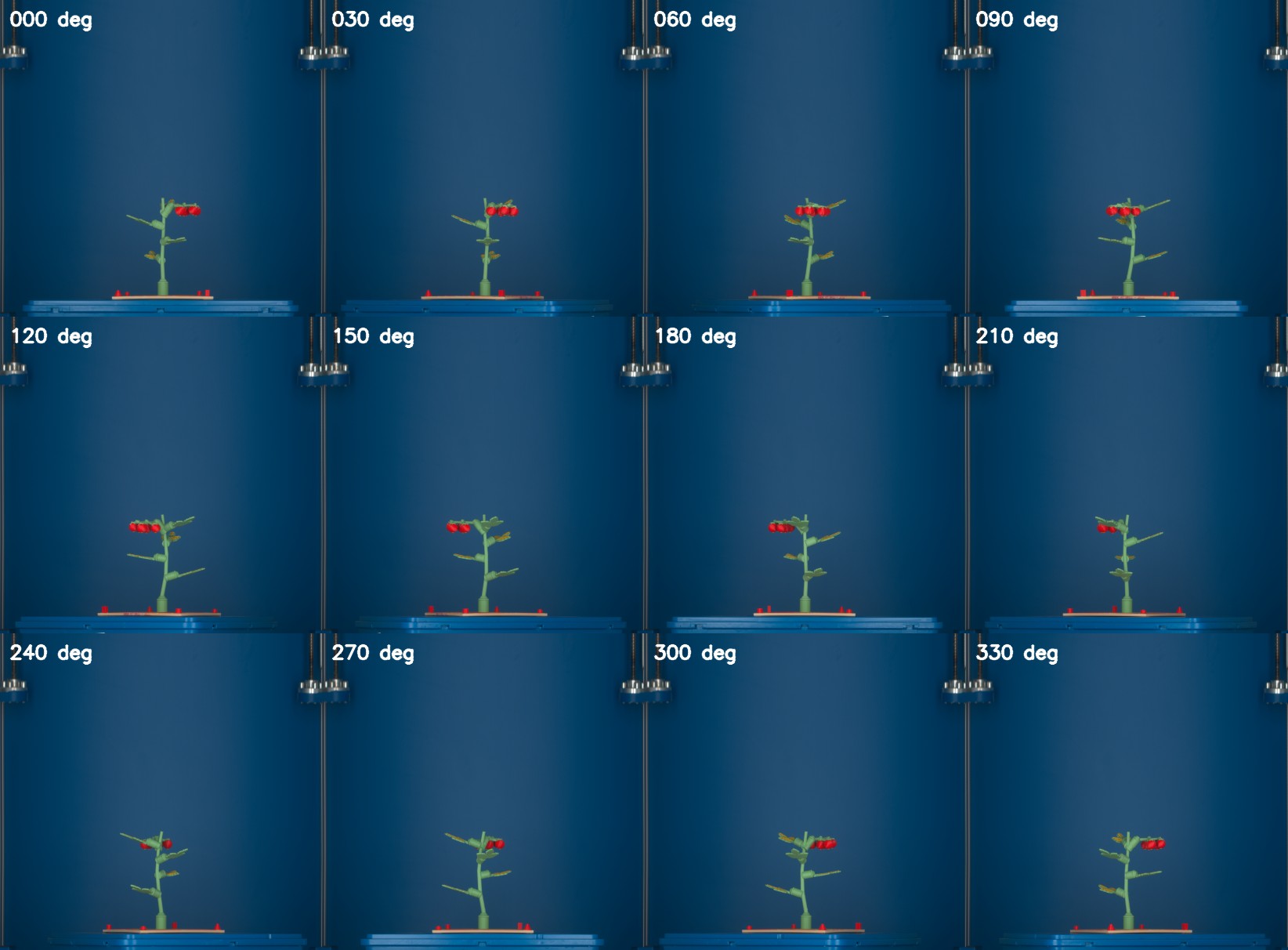
Contact sheet of the complete 72-view Helios orbit at five-degree increments
72-view orbit sheetEvery corrected input frame, in acquisition order.
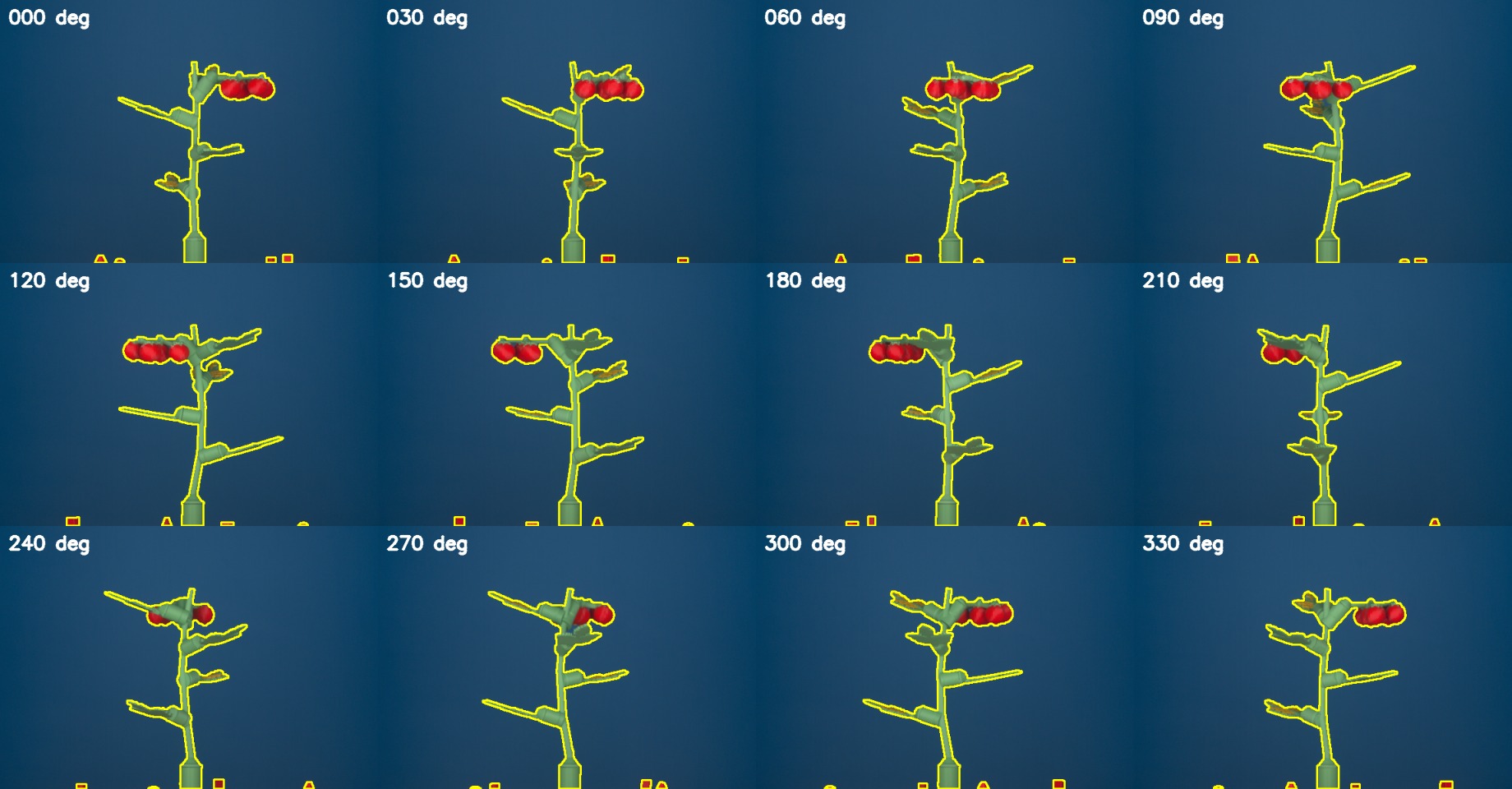
Quality-control montage showing target masks used in the image-space projection analysis
Segmentation quality controlRepresentative masks behind the silhouette, edge, and appearance descriptors.

Audit trail

What the benchmark does—and does not—claim

The frozen post-processing algorithm is version 2.1.0. Public reports carry artifact hashes, source-view gates, a fixed mixed-orientation pixel contract, and no absolute local paths.

Visual reconstruction layer

The Helios Gaussian view is initialized from the 16,274 measured S3D target points and optimized with 71 corrected RGB1 side-orbit images; A000 is withheld for validation. Its photogrammetry option is a separate 72-view known-pose RGB1 silhouette visual hull with an image-derived texture atlas. It is experimental, not dense MVS, and does not fuse S3D geometry.

Each phone has a matched 5,000-step OpenSplat appearance result using 90 RGB training views and one held-out view, plus its final canonical textured Apple Object Capture mesh. The splats use the final mesh surface as a geometric seed but do not ingest the auxiliary-depth channel. The CAD metrics remain based on the measured Helios point cloud and the phone meshes—not the appearance splats.

Primary surface sampling and representation

The CAD uses 100,000 triangle-area-uniform samples with NumPy PCG64 seed 20260811. Each phone mesh uses 100,000 samples with seed 20260812. Before sampling, every phone is isolated with the same complete-target rectangular prism at a 5 mm CAD margin, retaining every disconnected surface inside it and applying no component filter. Distances use exact Euclidean nearest-neighbour lookup.

Helios contributes all 16,274 retained canonical measured points rather than an interpolated mesh surface. That representation difference is explicit so the measured-point and triangle-surface outputs are not treated as identical geometry products.

Apple Object Capture and auxiliary-depth evidence

The untouched source sets contain 98, 100, and 101 HEICs for iPhone 12, 15, and 17 Pro Max respectively. Every frame verifies its model in make/model metadata, matches its package-manifest hash, and contains auxiliary depth, confidence, calibration, wide-to-depth transform, and point-cloud metadata.

All three phones use the same Apple PhotogrammetrySession settings: reduced detail, high feature sensitivity, sequential sample ordering, object masking off, bounding box ignored, and model + poses + bounds requested. The full HEIC containers—not JPEG conversions—are supplied to Object Capture.

The audit classifies the embedded channel as sensor-unclassified auxiliary depth because neither ImageIO nor the package identifies its sensor modality. Object Capture does not expose whether its final mesh used that channel, so this page does not relabel it as verified LiDAR or imply causal depth assistance.

The scored geometry is an Apple Object Capture photogrammetry mesh—not a raw LiDAR point cloud, raw ARKit scene mesh, or Gaussian splat.

Metric registration and scale

All three phones use the same direct four-AprilTag multiview metric-rigid recovery. Maximum per-tag reprojection RMSE is 4.091 px for iPhone 12, 4.937 px for iPhone 15, and 5.320 px for iPhone 17; all pass the explicit 8 px publication gate. Rigid target-fit RMSE/p95 is 0.255/0.339 mm, 0.604/0.813 mm, and 1.528/1.856 mm respectively.

The solve accepts only target IDs 12, 13, 26, and 27. Other AprilTags in the room are irrelevant and never enter the correspondence set. The 10 px upstream filter is a separate whole-marker-frame, all-corner observation gate.

Native Object Capture metres remain fixed at 0.001 native units per CAD millimetre. No free scale is applied. The scorer performs no ICP, registration, similarity rescaling, or reflection. Helios retains its independently validated fixed-scale proper-rigid target registration.

Reference and dimensional limits

The reference is the FULL_BORE_v1 corrected scan-visible CAD revision for PF-T31-00001059-C694BB02. Despite the source filename’s “as-built” wording, it is nominal corrected CAD—not a CMM measurement of this printed specimen.

Width and depth measure coherent physical platform side walls from each full raw reconstruction in the exact z=0–4 mm band, with fixed native scale and no CAD-centred normal-axis crop. Height is the local apex-cap centre above the AprilTag top-surface plane, not total envelope height.

Parameter, stratified-deletion, and half-sector sensitivity are reported as estimator confidence on one reconstruction—not independent-capture precision. Full bidirectional surface errors remain visible so skirts and extra shells are not hidden.

Why 24 views are not yet validated

The finished PCD has no per-angle provenance. Removing points would test point decimation, not capture count. Each balanced image subset must be reconstructed independently in Helios.

The acceptance plan allows median worsening ≤0.5 mm, p95 worsening ≤1.0 mm, CAD-coverage drop ≤3 percentage points at 2 mm, additional height-bias magnitude ≤1.0 mm, and additional base width/depth bias ≤0.5 mm relative to 60 views, with all five fruits and four leaf modules supported.

Public result package

Audit the final results

Download the final four-system result, interactive viewer data, visual reconstructions, and the separate Helios angle study.

JSONFinal four-system benchmarkHeadline CAD-support and two-way deviation metrics for Helios and all three iPhones JSONPublic common surface reportFinal Helios + phone metrics, representation contract, and fixed registrations CSVPrimary surface rowsBoth error directions, threshold completeness, representations, and sample counts JSONStrict phone mesh reportFinal 100k surface scores, 2.1.0 publication gates, source-view checks, and fixed registration evidence JSONCAD-supported organsExpected-part support, strength classes, and the fixed organ scoring contract JSONHEIC and depth provenanceEXIF models, sensor-unclassified auxiliary-depth counts, reconstruction settings, artifacts, and hashes JSONPage comparison dataFour-system metrics, boundary-derived dimensions, recovery, capture, and visual references JSONPhysical target dimensionsFull raw-reconstruction width, depth, and local apex-cap-height measurements with sensitivity and artifact hashes CSVPhysical dimension rowsMeasured, nominal, signed-bias, confidence, and sensitivity fields for all four systems CSVAnalysis-ready comparisonPrimary common values with explicit device representations JSONVisual reconstruction provenanceInput counts, reconstruction modalities, model artifacts, and SHA-256 hashes 3DGSHelios S3D + RGB1 Gaussian splatMeasured-S3D-seeded visual reconstruction · 71 train + 1 held-out projection PLYFull trained Helios Gaussians39,721 cropped target-prism Gaussians with full spherical-harmonic fields GLBHelios experimental photogrammetryKnown-pose 72-view RGB1 silhouette visual hull with calibrated image texture JSONMatched phone appearance provenanceShared OpenSplat contract, held-out validation, crop QA, artifact hashes, and thumbnail sources 3DGSiPhone 12 Gaussian splatFinal-mesh-seeded, RGB-optimized · 90 train + 1 held-out view 3DGSiPhone 15 Gaussian splatFinal-mesh-seeded, RGB-optimized · 90 train + 1 held-out view 3DGSiPhone 17 Gaussian splatFinal-mesh-seeded, RGB-optimized · 90 train + 1 held-out view PLYFull iPhone 12 GaussiansComplete trained OpenSplat attributes in the canonical metric frame PLYFull iPhone 15 GaussiansComplete trained OpenSplat attributes in the canonical metric frame PLYFull iPhone 17 GaussiansComplete trained OpenSplat attributes in the canonical metric frame GLBiPhone 12 textured meshFinal canonical Apple Object Capture visual reconstruction GLBiPhone 15 textured meshFinal canonical Apple Object Capture visual reconstruction GLBiPhone 17 textured meshFinal canonical Apple Object Capture visual reconstruction 3DiPhone 12 viewer subset30,000 deterministic canonical mesh-surface samples with primary CAD residuals 3DiPhone 15 viewer subset30,000 deterministic canonical mesh-surface samples with primary CAD residuals 3DiPhone 17 viewer subset30,000 deterministic canonical mesh-surface samples with primary CAD residuals PLYShared CAD viewer sampleExact 12,000-point canonical CAD layer in millimetres · class 0 DESIGNPF-T31 Tomato calibration targetOpen the editable iPhonoBenchy target and export an STL. STLAssembled calibration targetFULL_BORE_v1 benchmark CAD · complete target in one STL file PLYiPhone 12 canonical exampleExact 30,000-point browser surface with residual RGB and error_mm · class 1 PLYiPhone 15 canonical geometryFinal canonical viewer points with residual RGB and error_mm · class 1 PLYiPhone 17 canonical geometryFinal canonical viewer points with residual RGB and error_mm · class 1 JSONFinal Helios metrics and angle dataFinal common Helios values plus the separate image-space angle screen CSVFinal metric summaryFinal common four-system rows with explicit scopes and units CSVProjection subsetsEvery tested view count and exact balanced angles CSVHelios rerun planRecommended phases for the 3D confirmation experiment PLYHelios measured geometry16,274 canonical measured points used by the final Helios score PLYHelios CAD display overlayMeasured scan and deterministic reference display samples JSONRegistration transformFixed-scale transform, bootstrap stability, and provenance JSONFull angle analysisMethod, phase variants, descriptors, timing, and quality control MDPackage notesProvenance, limitations, field definitions, and checksum instructions SHAChecksumsSHA-256 for the published page data and downloads