Measured on 10 August 2026 · 72-view orbit

Helios supported almost all CAD within 5 mm—and retained a wider off-surface tail.

A fixed-scale comparison of one Helios reconstruction with the exact PF-T31-00001059-C694BB02 corrected scan-visible CAD reference. The result separates CAD completeness from retained off-surface deviation and screens how far the 72-view orbit may be reduced.

Fixed 1:1 scale Proper rigid registration 16,274 target points Four-system CAD context No CMM metrology

Measured result

The 72-view reconstruction at a glance

CAD within 2 mm 85.45%

Reference surface with nearby Helios support

Scan → CAD median 1.686 mm

Typical registered surface deviation

Robust dimensions +0.70 · +0.99 · −1.81%

Width · depth · height bias

Reduced-view candidate 24 views

Image-space hypothesis; 3D rerun pending

Combined-system error, not scanner-only bias. Residuals include the physical print, connector seating, Helios reconstruction, rigid registration, occlusion, and sparse sampling. No caliper or CMM measurement of this specimen was available.

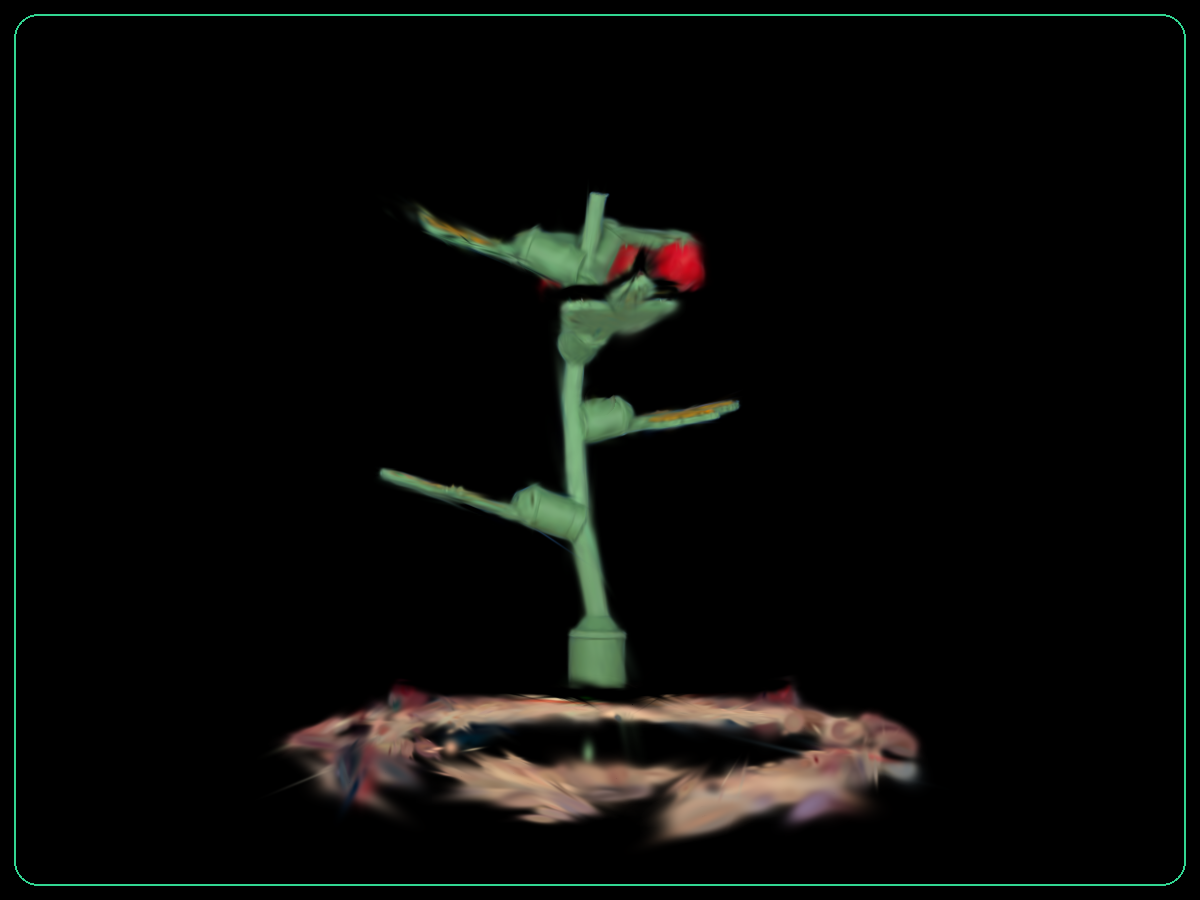
Interactive registered geometry

Inspect where the scan departs from CAD

All 16,274 target-prism scan points are shown—no enrichment of the worst residuals. The CAD layer is a deterministic 8,000-point surface sample.

Signed-normal summary statistics cover the 14,459 supported Helios points within 5 mm; signed colours on the retained tail are exploratory.

Choose Helios or an iPhone scan with the system menu. The point overlay is accompanied by keyboard-accessible camera presets, the full comparison table below, and downloadable metrics. Point-by-point picking requires a pointer.

Two directions, two questions

Completeness and surface deviation separate cleanly

Nearest-neighbour direction matters. Reporting only one direction would hide the core Helios trade-off.

Helios pointsCAD

How far did reconstructed points depart from the model?

Median1.686 mm
p957.245 mm
RMSE3.167 mm

A wider tail remains around the base, tray boundary, thin edges, and difficult surfaces.

CADHelios points

How completely did the scan support the reference?

Median1.120 mm
p952.849 mm
≤ 5 mm99.93%

Nearly all sampled CAD has nearby Helios support, including much of the thin plant geometry.

Surface metrics by scope

All distances in millimetres
Scope Scan→CAD median Scan→CAD p95 CAD→scan median CAD→scan p95 CAD ≤2 mm CAD ≤5 mm
All target-prism points 1.6867.2451.1202.84985.45%99.93%
Diagnostic: scan points ≤5 mm 1.5154.0151.1202.84985.45%99.93%
Plant union 1.3834.0541.3123.40279.27%100.00%

The ≤5 mm row is a labelled diagnostic that removes the off-surface tail; it is not the primary result.

One CAD · four capture pipelines

Helios and three iPhones reveal different kinds of reconstruction error

Every column is rescored against the same 55,622-point FULL_BORE_v1 CAD sample. No single metric is allowed to stand in for “accuracy.”

Comparable scoring, not a controlled hardware shoot-out.

These are single complete capture-and-reconstruction runs with different trajectories, image counts, software, point densities, and registration routes. The iPhone 15 overlay was already plate-scaled and plant-aligned on device, then rescored with the common distance and extent definitions. Helios and the iPhone 12/17 runs retained fixed metric scale during their CAD registrations.

Finest CAD supportiPhone 15 · 88.96%

Highest sampled-CAD coverage within 2 mm.

Near-complete supportHelios · 99.93%

Within 5 mm; iPhone 15 follows at 99.85%.

Lowest completeness tailHelios · 2.849 mm

Best CAD→scan p95, narrowly ahead of iPhone 15.

Dimensions splitHelios X/Y · iPhone 15 Z

Closest width/depth versus closest height.

Expected organs supported44/44 on all iPhones

Helios supported 42/44 leaflets; all runs supported 4 leaves and 5 fruits.

Capture-only time2:32 on iPhone 15

Versus 33:18 for the complete Helios orbit.

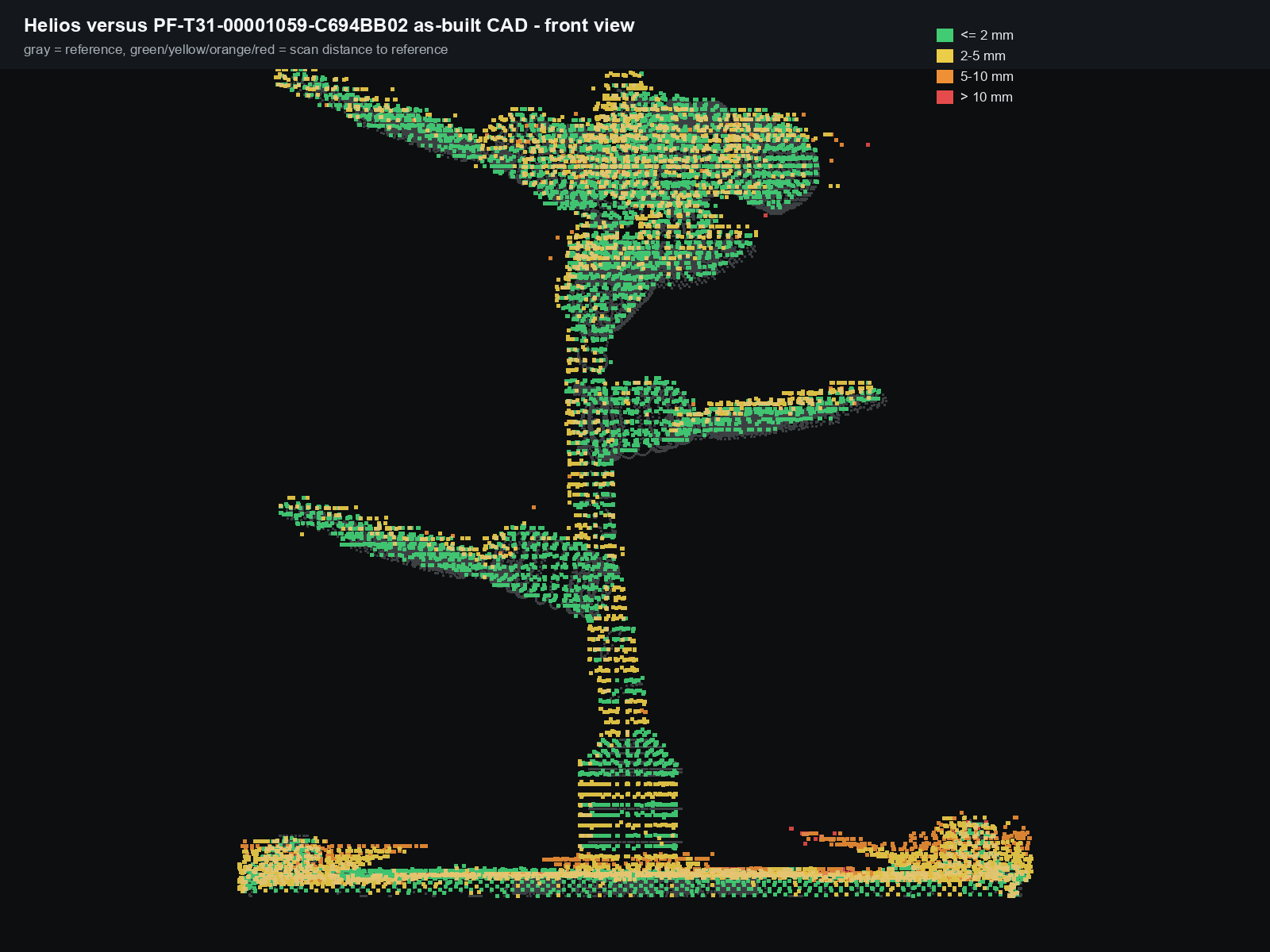
Front CAD residual comparison for the Helios reconstruction
Helios · front · gray CAD with scan points coloured by absolute CAD distance

Same-CAD normalized comparison

Bold cells identify the strongest observed value for that row—not an overall winner.

Lower ↓ or higher ↑ as marked
MetricHeliosiPhone 17 Pro MaxiPhone 15 Pro MaxiPhone 12 Pro Max
Surface support and deviation
CAD within 2 mm ↑85.45%79.05%88.96%74.98%
CAD within 5 mm ↑99.93%96.06%99.85%94.90%
Scan→CAD median ↓1.686 mm0.841 mm1.190 mm0.739 mm
Scan→CAD p95 ↓7.245 mm3.658 mm6.152 mm3.369 mm
CAD→scan p95 ↓2.849 mm4.400 mm2.946 mm5.041 mm
Symmetric mean ↓1.828 mm1.404 mm1.508 mm1.412 mm
Robust dimensions
Width bias · |error| ↓+1.055 mm+3.620 mm+2.476 mm+2.405 mm
Depth bias · |error| ↓+1.482 mm+3.088 mm+2.269 mm+2.540 mm
Height bias · |error| ↓−2.943 mm−3.679 mm−0.884 mm−4.742 mm
Mean absolute W/D/H bias ↓1.827 mm3.462 mm1.876 mm3.229 mm
Reference-supported structure and acquisition
Compound leaves4/44/4 high4/4 strong4/4 high
Fruits5/55/5 moderate5/5 strong5/5 moderate
Leaflets42/4444/44 high44/44 strong44/44 · 39 high
Capture duration ↓33:184:082:323:27
Capture samples72 projection views139 RGB · 121 registered91 RGB · 72 exported poses120 RGB · 101 registered
Registered target points16,27414,43728,23311,251

The iPhone 12/17 clouds are sparse, so their low Scan→CAD residuals partly reflect selective sampling of easier surfaces. CAD→scan and CAD-coverage rows expose what was missed. Capture durations exclude reconstruction and training time.

Scan → CAD

Conformity of retained points

Answers “how far are the reconstructed samples from the model?” It rewards clean points, but can look excellent when difficult or missing surfaces never produce points.

CAD → scan

Completeness of the reconstruction

Answers “how far must each CAD sample travel to find reconstructed support?” It reveals absent leaves, gaps, and under-sampled structures.

Registration matters

Same scoring, two registration tiers

Helios and iPhone 12/17 retain fixed metric scale during CAD alignment. The iPhone 15 result keeps its package-authored plate scale and bounded plant alignment before common-definition rescoring.

Counts are conditioned

Expected-organ support, not blind detection

Leaf, fruit, and leaflet counts test support at known CAD locations. They do not discover unexpected extra organs, and nearby parts can share points.

Device and geometry provenance. The iPhone 15 Pro Max model is verified in its HEIC metadata and the scored geometry is its Apple Object Capture photogrammetry mesh—not LiDAR or the package’s Gaussian splat. The iPhone 12/17 names come from their benchmark report; their package manifests say only “iPhone.” Those two columns score sparse Mac-side SfM clouds associated with this CAD through all four AprilTags, but no QR identity observation was packaged.

Shape and structure

Dimensions stayed close; thin leaflets were the main losses

Extents use registered p0.5–p99.5 surface bounds. Component counts are reference-supported—not blind detections.

Width151.055 mmCAD 150.000 mm
+1.055 mm +0.70%
Depth151.482 mmCAD 150.000 mm
+1.482 mm +0.99%
Height159.525 mmCAD 162.468 mm
−2.943 mm −1.81%
4/4compound leaves
5/5fruits
42/44leaflets

31 leaflets had strong support, 11 were moderate or partial, and 2 were insufficient.

Corner fiducials and CAD-conditioned volume Open advanced results
FiducialCentre errorLocal scale biasForm RMSECAD→scan p95
A · short cylinder0.274 mm−2.21%0.956 mm1.865 mm
B · tall block0.493 mm−1.63%0.988 mm1.735 mm
C · reinforced frustum0.217 mm−0.52%0.848 mm1.439 mm
D · low dome0.109 mm−1.43%0.903 mm1.536 mm

The CAD-guided plant exterior-volume proxy was 37.716 cm³ versus a 37.555 cm³ CAD union (+0.429%). This is a model-assisted local-scale consistency check, not independent scan-only enclosed volume.

Projection-angle screen

Twenty-four views mark the image-space knee

The screen ranks angular redundancy. It identifies which subset to reconstruct next; it does not prove reduced-view 3D equivalence.

24 views 80.03 held-out image score
versus
60 views 81.14 held-out image score
Estimated sweep 11:06 22:12 saved versus 72 views
Balanced subset screenHeld-out composite coverage
Best phasePhase range

The 72-view value is not connected: with no held-out frames, its 100% score is definitional and not comparable to this curve.

Explore a balanced orbit24 selected views
Score80.03
Sweep11:06
Largest gap15°
Angles 5, 20, 35, 50, 65, 80, 95, 110, 125, 140, 155, 170, 185, 200, 215, 230, 245, 260, 275, 290, 305, 320, 335, 350
24

Recommended first rerun. Exact 15° spacing on the available 5° lattice; only 5.9% more held-out proxy error than 60 views.

20

Aggressive lower bound. Alternating 15°/20° gaps; 17.9% more held-out proxy error than 60 views.

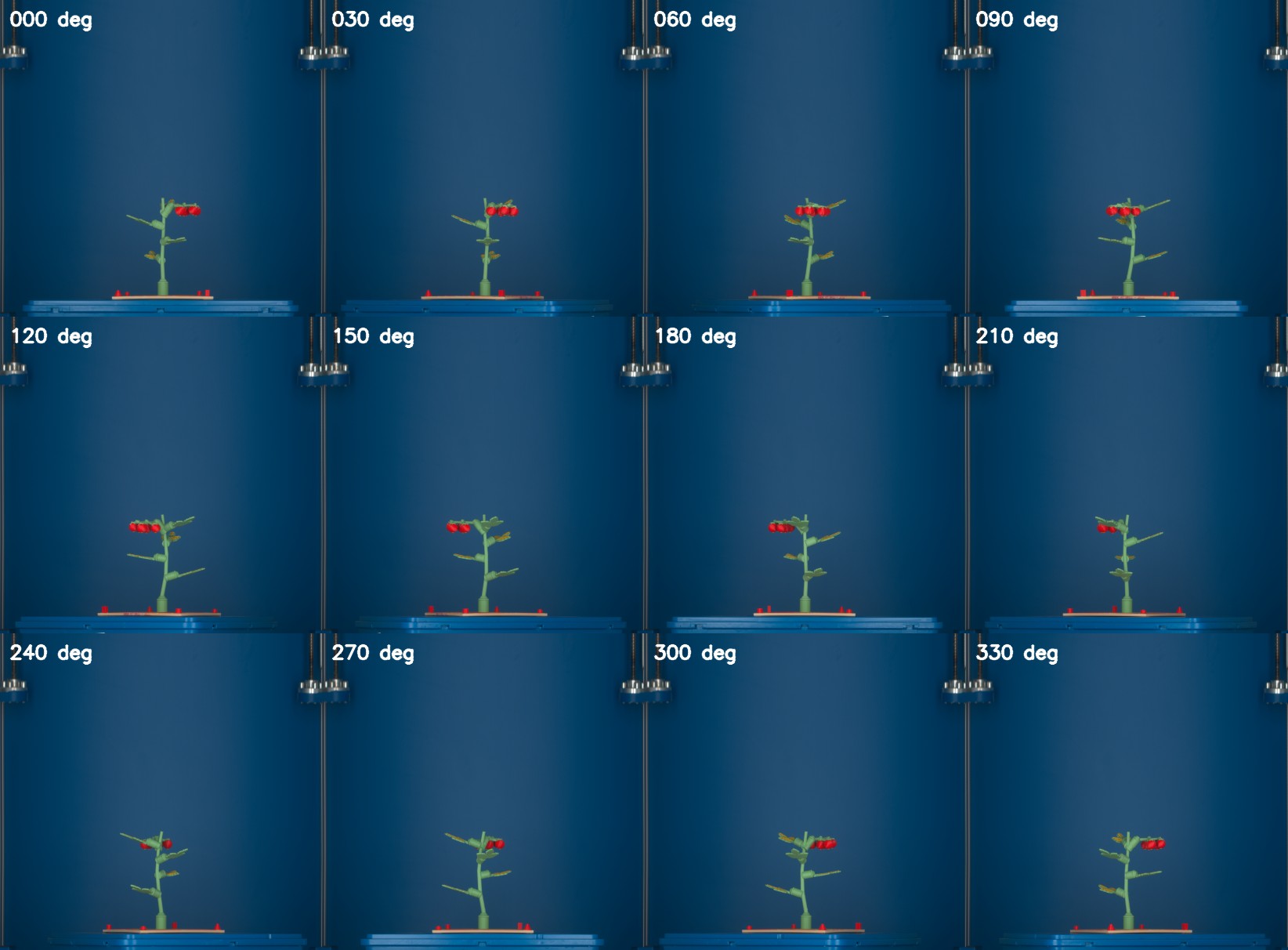
Contact sheet of the complete 72-view Helios orbit at five-degree increments
72-view orbit sheetEvery corrected input frame, in acquisition order.
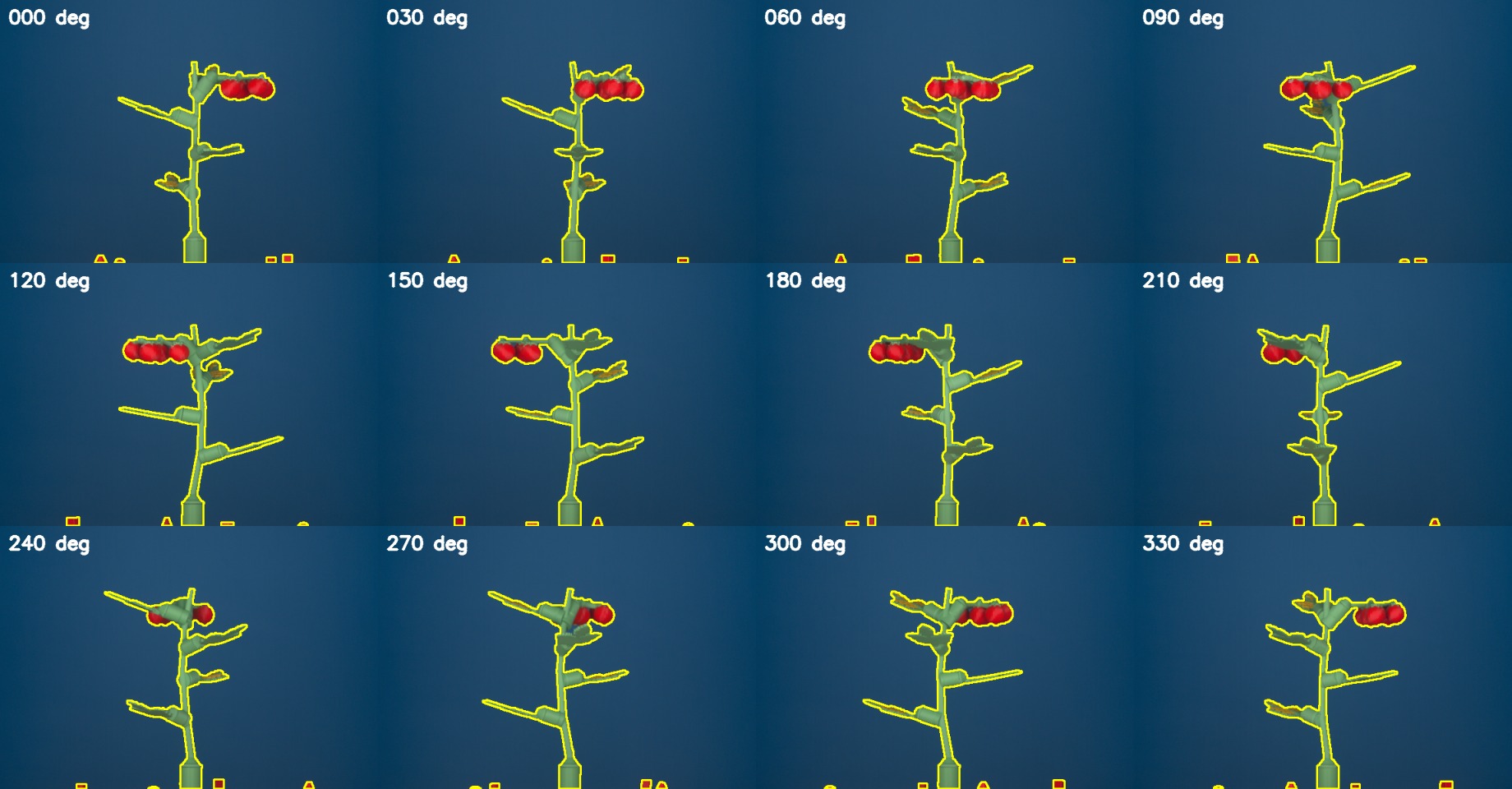
Quality-control montage showing target masks used in the image-space projection analysis
Segmentation quality controlRepresentative masks behind the silhouette, edge, and appearance descriptors.

Audit trail

What the benchmark does—and does not—claim

The primary surface result never rescales the scan. Every public download is sanitized and checksum-listed.

Registration and metric scale

The surrounding Helios tray is excluded with a known-target prism. A proper rigid transform is refined with 75%-trimmed ICP while holding scale at 1.000 mm/mm.

Eight 80% resamples changed translation by a median 0.106 mm and rotation by 0.064°. A free-scale diagnostic preferred +0.836%, but that rescaling is excluded from the primary bias.

The PCD itself does not declare units. Its native coordinates are consistent with millimetres under the known 150 mm target registration.

Reference provenance

The reference is the FULL_BORE_v1 corrected scan-visible CAD revision for PF-T31-00001059-C694BB02, derived from the target design and corrected assembly datums.

Despite the source filename’s “as-built” wording, this is not a CMM-measured physical mesh. Print warping, surface texture, and real connector seating error are not encoded.

Signed bias and dimensions

Signed residual follows the nearest local CAD triangle normal. Positive means outward. The all-supported median is +0.634 mm, but signs are less stable at thin leaves and edges where the nearest triangle can change.

Robust extents can contract when surfaces are missing. The plant-only horizontal envelope is therefore an occlusion diagnostic, not a direct material-size measurement.

Why 24 views are not yet validated

The finished PCD has no per-angle provenance. Removing points would test point decimation, not capture count. Each balanced image subset must be reconstructed independently in Helios.

The acceptance plan allows median worsening ≤0.5 mm, p95 worsening ≤1.0 mm, CAD-coverage drop ≤3 percentage points at 2 mm, additional height-bias magnitude ≤1.0 mm, and additional base width/depth bias ≤0.5 mm relative to 60 views, with all five fruits and four leaf modules supported.

Public result package

Take the metrics and geometry with you

Local paths and ambiguous secondary fields have been removed. Checksums cover every published result file.