Hardware rationale · evidence brief
Why iPhone for metric 3D capture?
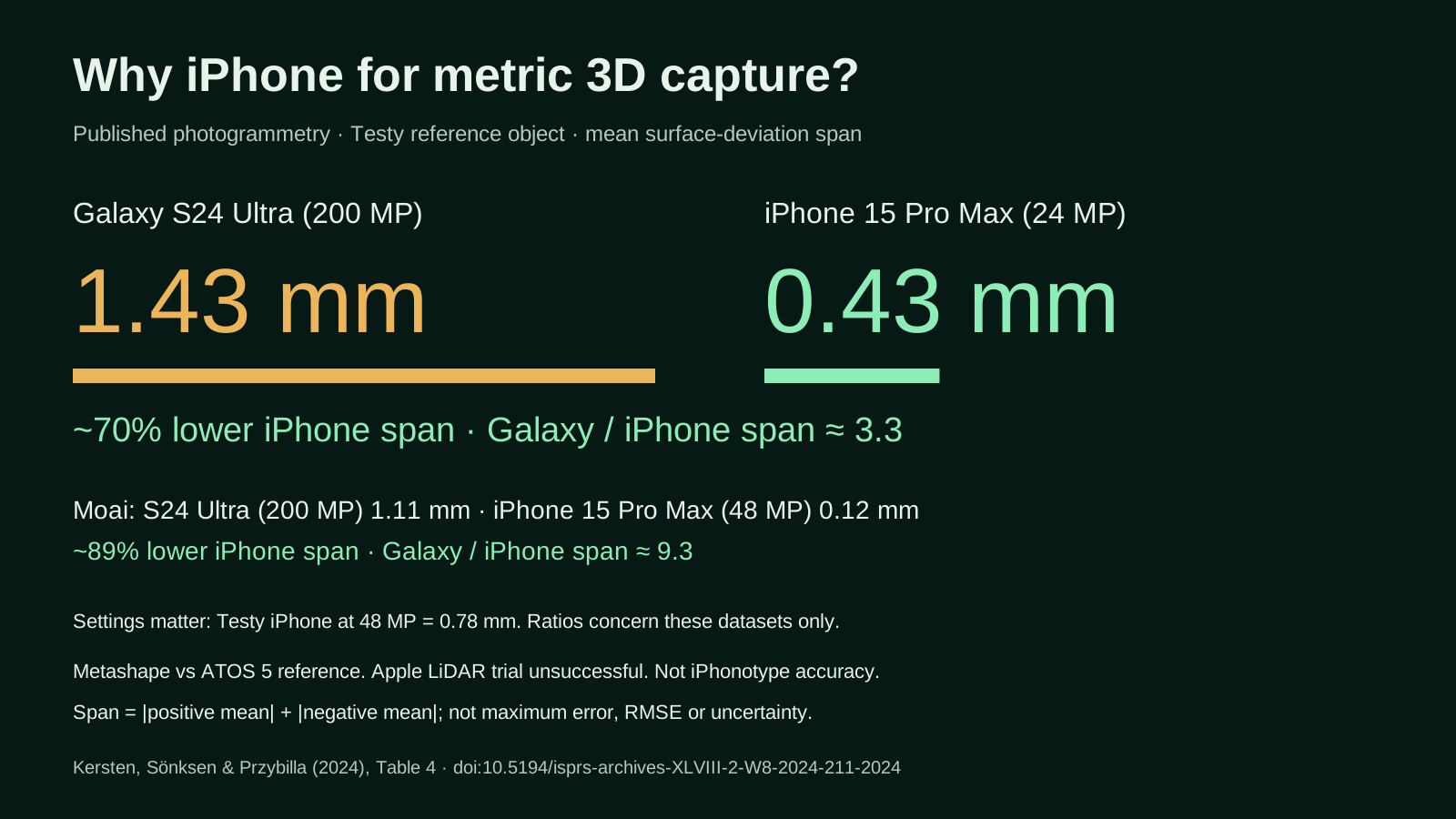
TESTY REFERENCE OBJECT · MEAN SURFACE-DEVIATION SPAN
Camera-only benchmark · not LiDAR or iPhonotype accuracy
~70% lower iPhone span Galaxy span ÷ iPhone span ≈ 3.3 · this Testy dataset only
Settings matter: the same iPhone at 48 MP yielded a 0.78 mm Testy span. Image counts and capture settings differed; these ratios apply only to the reported datasets.
Camera-based photogrammetry, not a LiDAR comparison. The Testy and Moai meshes were compared with ATOS 5 structured-light references. The Apple LiDAR attempt produced no useful recording. These object-specific results do not measure iPhonotype accuracy.
Kersten, Sönksen & Przybilla (2024), Table 4 · Span = |positive mean| + |negative mean|; not maximum error, RMSE or measurement uncertainty.
Metric depth without per-plant targets
Controlled photogrammetry can achieve high geometric accuracy on both iPhone and Android under favourable conditions. Accuracy of one scaled reconstruction is different from metric repeatability across independently captured plants.
AprilTags or scale bars can supply external metric scale to RGB photogrammetry. iPhonotype was explicitly designed to avoid requiring calibration targets for every plant acquisition. LiDAR supplies integrated metric depth during capture, reducing that operational burden; it is not universally more precise than photogrammetry.
From single-scan accuracy to between-scan repeatability →
Apple lists a LiDAR Scanner on the iPhone 15 Pro Max. Samsung’s S24 Ultra specifications list Laser AF and do not list a LiDAR/ToF component. The S24 Ultra also supports ARCore Depth API; this is a named-device distinction, not a claim that Android cannot measure depth.
Apple’s ARKit scene-depth API provides LiDAR-derived depth on supported hardware, with confidence information. Google’s Depth API can derive depth from camera motion and fuse supported hardware depth sensors. Some Android devices have ToF sensors; S24 Ultra is Depth API-capable but is not marked as a supported hardware-ToF model in Google’s device list. A Laser AF designation is not evidence of an equivalent app-accessible scene-depth map. These specifications establish sensing/API differences, not a universal accuracy advantage.
01 · Published camera reconstruction
Same reference bodies, Metashape 2.0 workflow and ATOS 5 reference; calibrated scale bars supplied scale. Image resolution and image counts differed. The paper reports one result per listed device–object–resolution cell, three operators with differing experience, incomplete device–object coverage, and no test–retest or uncertainty analysis. Reference-registration algorithms and settings are not specified. The span summarises signed surface deviations, not a bound on individual errors. Testy standard deviations were 2.00 mm (S24 Ultra) and 0.86 mm (iPhone 15 Pro Max, 24 MP).
| Device | MP | Positive mean | Negative mean | Span |
|---|---|---|---|---|
| Nikon D7500 | 20 | +0.28 | −0.27 | 0.55 |
| Galaxy S21+ | 64 | +0.60 | −0.75 | 1.35 |
| Galaxy S22 | 12 | +0.37 | −0.47 | 0.84 |
| Galaxy S23 | 48 | +0.31 | −0.40 | 0.71 |
| Galaxy S24 Ultra | 200 | +0.47 | −0.96 | 1.43 |
| iPhone 13 Pro | 12 | +0.25 | −0.25 | 0.50 |
| iPhone 15 Pro Max | 24 | +0.22 | −0.21 | 0.43 |
| iPhone 15 Pro Max | 48 | +0.32 | −0.46 | 0.78 |
The slab used a separate fitted-plane assessment, not an ATOS object reference: its mean-deviation span was 0.09 mm for both S24 Ultra (200 MP) and iPhone 15 Pro Max (24 MP).
Einstein: 0.63 mm (S24 Ultra) versus 0.33 mm (iPhone 13 Pro, 12 MP). No iPhone 15 Pro Max Einstein result is reported. These laboratory objects are not living plants; the ratios are descriptive, not universal device rankings.
Published reconstruction deviation maps
Original Figures 3, 5 and 6 show signed surface deviations, in millimetres, against the reference geometry. Read the retained colour scales: green is near zero, while red and blue indicate opposing deviation directions. Visible gaps provide qualitative reconstruction-completeness context; these figures do not report a coverage percentage or between-scan repeatability.
Figure 3 · Testy
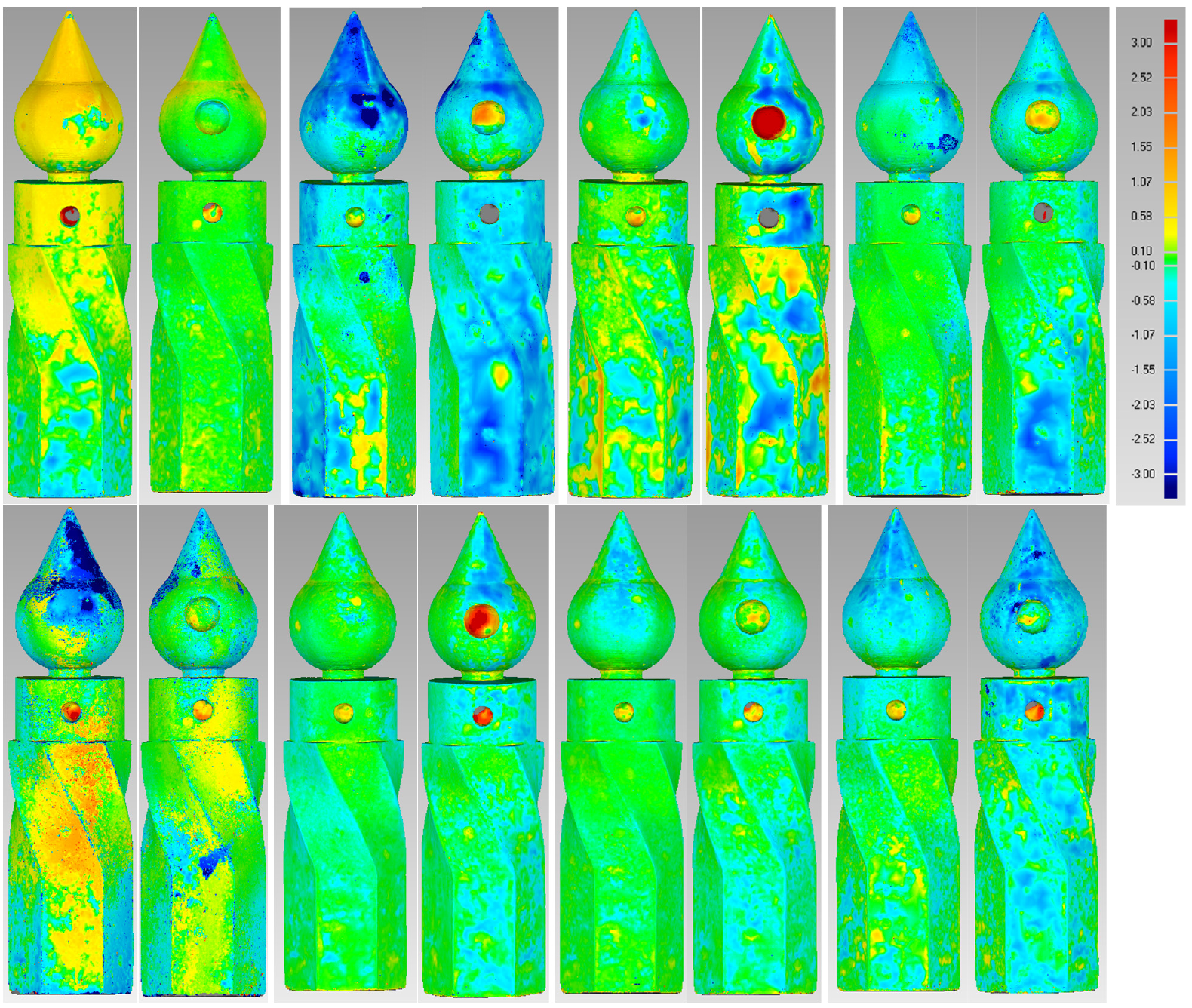
Figure 5 · Moai
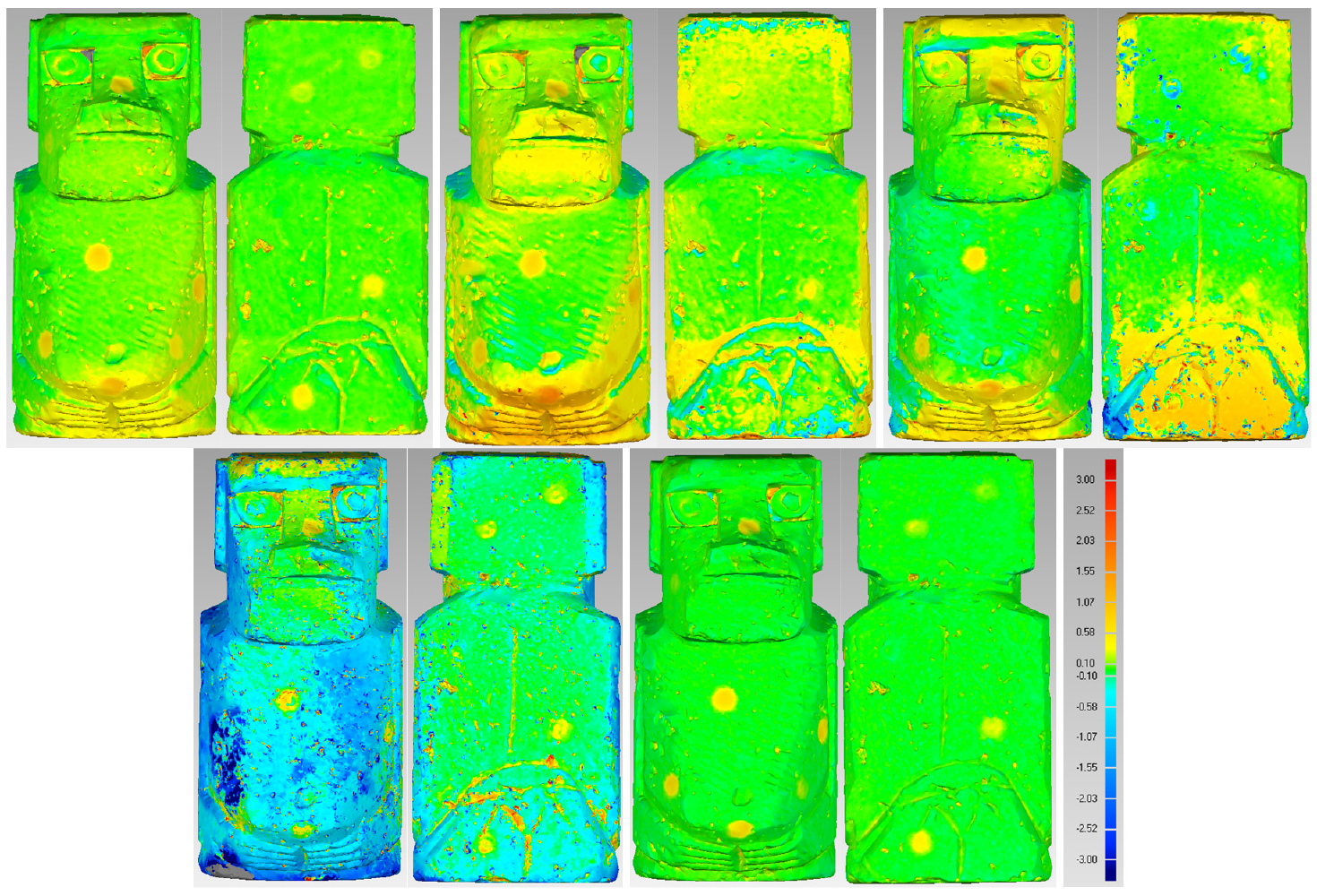
Figure 6 · Einstein
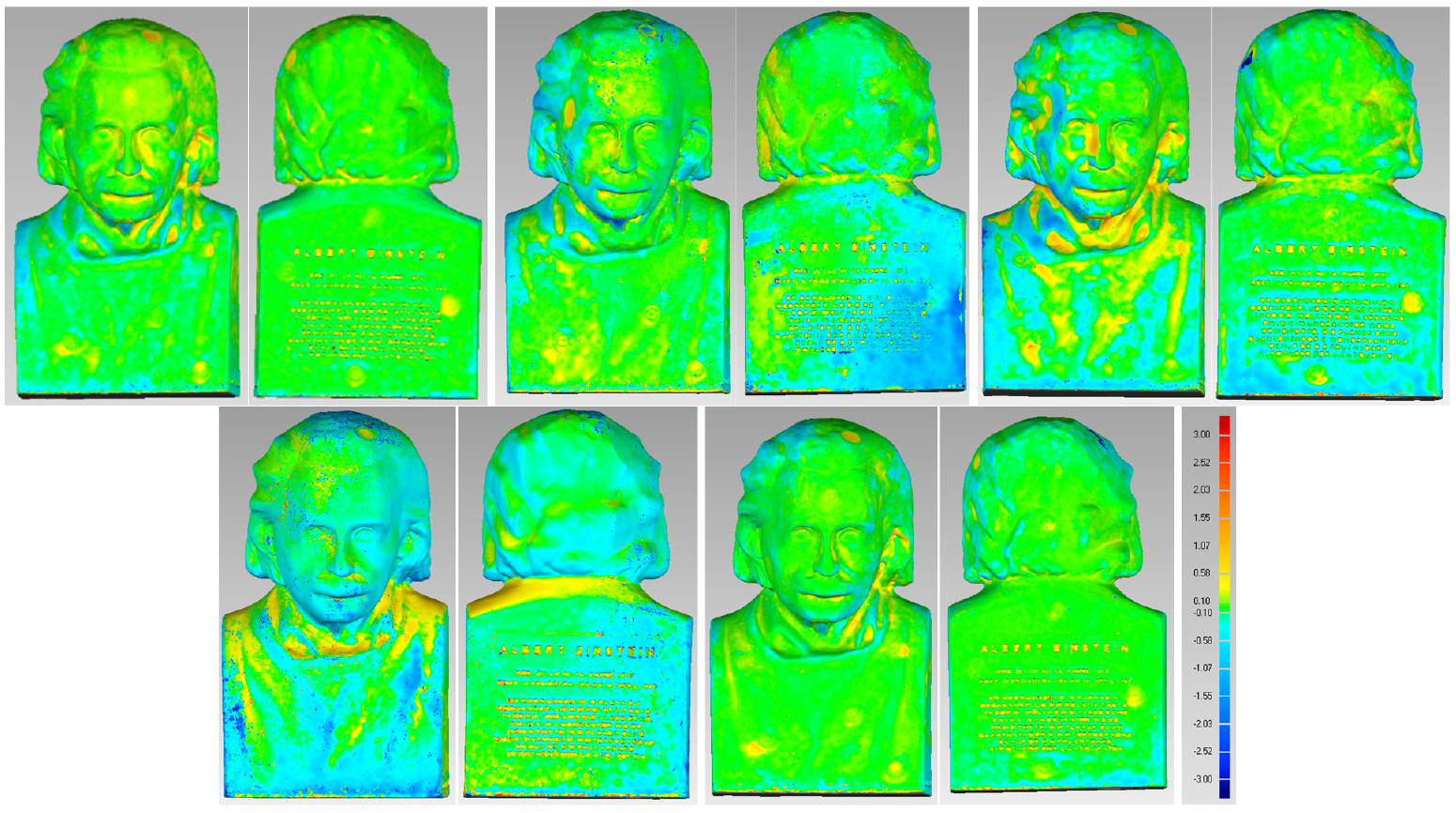
Figures © Kersten, Sönksen & Przybilla (2024), reproduced under CC BY 4.0. Cropped from the paper to remove surrounding text; colours, panels and legends are unchanged. Captions and device-order labels above are provided by iPhonotype. These are image-based Metashape results, not LiDAR or iPhonotype measurements.
02 · Independent mobile scanning evidence
Mobile 3D performance depends on the complete workflow, not the phone alone. These studies concern different apps, targets and sensing modes; their numbers must not be pooled with Kersten et al. or transferred to iPhonotype.
- LiDAR / Polycam and Scaniverse. Askar & Sternberg (2023) compared iPhone 13 Pro indoor scans from Polycam, Scaniverse, SiteScape and 3D Scanner App against terrestrial laser scanning. App-dependent errors, drift, clutter and missing surfaces limit transfer to small plant structures.
- Camera photogrammetry / KIRI Engine. Lankia & Ala-Laurinaho (2024) compared KIRI Engine, Polycam, WIDAR and MagiScan on a crane hook using image-based reconstruction. External scale correction and discarded failed/incomplete models affect interpretation; this is not LiDAR evidence.
- Plant-domain mobile LiDAR. Doyle & Raturi (2026) evaluated mobile LiDAR/RGB scans of pepper, tomato and watermelon. The study supports in-situ feasibility while showing trait-dependent errors; its validation is not a performance specification for iPhonotype.
- Geoscience-scale iPhone LiDAR. Luetzenburg, Kroon & Bjørk (2021) evaluated the iPhone 12 Pro LiDAR in a separate application domain. Object scale, surfaces and acquisition paths differ from plant phenotyping.
Polycam photo processing in Kersten et al. is a separate image-based workflow, not evidence that LiDAR caused the Metashape results.
03 · iPhonotype validation and repeatability
The contribution to test is stable quantitative traits across independent acquisitions without per-plant calibration targets, not only an accurate individual reconstruction. Repeatability experiments must report within-plant variation across repeated captures, numbers of plants and acquisitions, operators, conditions and failures. Comparisons across different plants alone do not establish test–retest repeatability.
Integrated depth provides a metric input, not a guarantee of repeatability. Capture coverage, reconstruction, registration and segmentation can still change the resulting traits. The repeatability report and target-free acquisition protocol must support any numerical claim; the external phone benchmark cannot supply that evidence.
The study did not test iPhonotype. Its numbers are not our accuracy specification. Our Helios-Benchy evidence and plant phenotyping evidence concern their own targets, capture protocols and metrics. Geometry, scale, registration and trait validity must be checked for each workflow.
Full citation: Kersten, T. P., Sönksen, L., and Przybilla, H.-J. (2024). Geometric Accuracy Investigations of Mobile Phone Devices in the Laboratory Using High-Precision Reference Bodies. ISPRS Archives, XLVIII-2/W8-2024, 211–218.
Download comparison graphic (SVG) · Download comparison graphic (PNG) · Download Testy data (CSV)